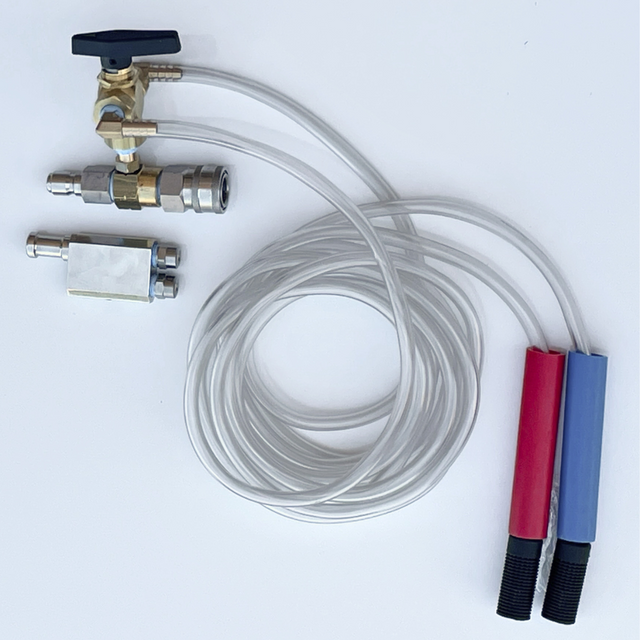
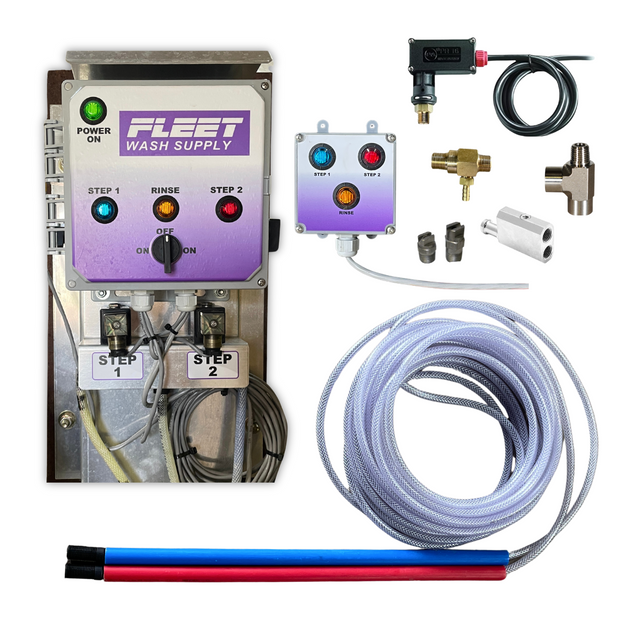
For downstreaming, dilute each chemical concentrate separately with water before use. We call this prepared mix RTU (ready to use). Your injector draws RTU from its container and adds water from the pressure washer. That further-diluted mix comes out of the wand and hits the truck’s surface at its final dilution.
What does a dilution ratio mean?
In our guides, dilution ratios are written as water to chemical. A 5:1 mix means five parts water to one part chemical concentrate, making six parts total. The “part” can be a gallon, a quart, or another measured amount, as long as you use the same unit for both ingredients.
For example, five gallons of water plus one gallon of concentrate makes six gallons of RTU. It will not fit in a five-gallon container. Decide how much RTU you want before measuring, and leave room in the container for mixing.
How much water and concentrate do you need?
Choose how many gallons of RTU you want to prepare. Move the slider from 5 to 30 gallons to see the water and concentrate amounts for 3:1, 4:1, and 5:1. Each row is a separate mixing option for one chemical.
| Water : concentrate | Water | Concentrate |
|---|---|---|
| 3:1 | 3.75 | 1.25 |
| 4:1 | 4.0 | 1.0 |
| 5:1 | 4.167 | 0.833 |
Amounts are rounded to 0.001 gallon. Choose one ratio for each chemical and keep Step 1 and Step 2 in separate containers. Your injector dilutes this RTU further during downstreaming.
Use a marked measuring container rather than estimating by eye. Follow the product label and SDS for mixing order, handling, and protective equipment.
Which ratio should you use for each chemical?
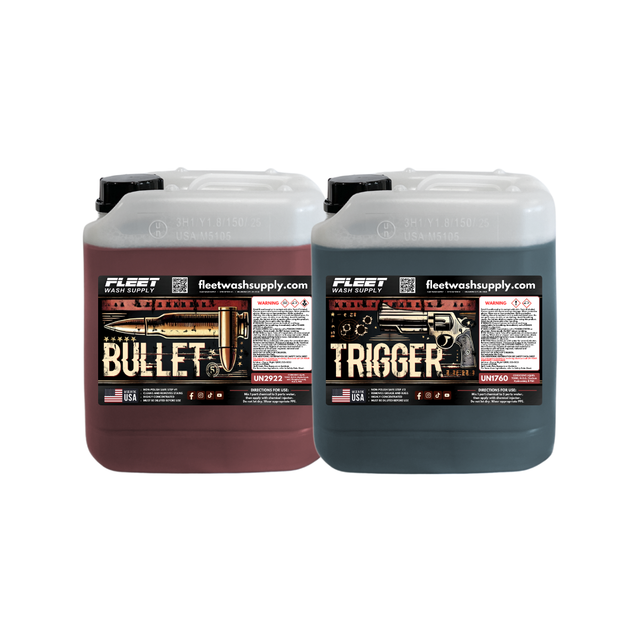
We recommend starting at 3:1 for Venom, 4:1 for Viper, and 5:1 for both Bullet and Trigger when preparing RTU for downstreaming. These are our recommended starting ratios. Adjust from there based on your injector draw rate, the surfaces you’re washing, and the buildup you’re removing. Measure each product separately: Venom and Viper start at different ratios, while Bullet and Trigger both start at 5:1.
Follow the instructions for your product and application method when adjusting the mix. The Venom + Viper listing and Bullet + Trigger listing show their mixing recommendations. If you need help matching a mix to your injector, contact us with your setup details.
Is the container mix the final dilution?
No. RTU is the prepared mix in your container. During downstreaming, your injector adds more water to that RTU. The resulting mix comes out of the end of the wand and hits the truck’s surface at its final dilution. Injector draw rate affects how much RTU enters the water stream and changes the chemical strength reaching the surface.
A container mixed at 5:1 therefore does not mean a final dilution of 5:1 on the vehicle. To work out the final dilution, you also need to know how your injector is drawing. Don’t assume a draw rate from the pressure washer’s PSI alone.
Keep Step 1 and Step 2 separate
Prepare Step 1 in its own container and Step 2 in another. Diluting each concentrate with water is part of preparation; combining the two chemicals in one container prevents them from working as intended in the two-step process. Apply Step 1, apply Step 2 directly over it, brush any areas that need it after Step 2, then rinse thoroughly.
If you’re new to the sequence, start with our two-step washing guide. If the truck still isn’t coming clean after mixing, use the troubleshooting guide before changing the chemical strength.
Need help with your mix?
Contact Fleet Wash Supply with the chemical names, the water and concentrate amounts in each container, your pressure washer’s GPM and PSI, and the injector you’re using. Those details help us check both the container mix and the application setup.